Showing posts with label Mosque Collection. Show all posts

Friday, August 10, 2012

Mosque Hunt - Guilin Ancient Mosque

During our travel to Guilin last year, we came about an old mosque situated not far from the hotel where we stayed. Built in the early years of the Yuan Dynasty, the Guilin Ancient Mosque was located along the Taohuajiang River.


The mosque covers an area of 5669 square meters. Its building is rather inwards making it not visibly spotted from the main street. Like many of the typical mosques in China, the Ancient Mosque was built with emphasis on symmetry that connotes a sense of grandeur.


The mosque was badly damaged during wars but it was rebuilt in the middle years of Ming Dynasty. It then suffered another unfortunate fate when during the Japanese occupation in Guilin. 

In 1944, the mosque was burnt after the Japanese occupied Guilin. After 1945 Muslims in Guilin began to raise funds for the reconstruction of the ancient mosque. Finally in 1947, the prayer hall and some auxiliary houses were built in combined efforts, and Guangxi Arabic Language School was established too.


Again in 1967, it was seriously ruined, resulting in the total disappearance of the grand occasions in the old days. After 1979, under the advocating of the Islam Association of the city, a start-up group responsible for the reconstruction of the mosque was founded. Not long after that, they began to raise funds in the rebuilding of the Guilin Ancient Mosque .


Fresh slaughtered meat sold at the entrance of the mosque


At present, there are about 4500 Muslims living in the community of Guilin Ancient Mousque, all of whom are Hui Nationality.

Wednesday, August 8, 2012

Mosque Hunt - Dewatagaha Mosque, Colombo

We stumble upon the Dewatagaha Mosque after a long walk from the Town Hall and the Colombo National Museum. Located in Lipton's Circus this mosque is just across the famous Odel Outlet.


The Dewatagaha Mosque is one of the oldest mosques in Sri Lanka. History of Dewatagaha mosque goes back to the 19th century, nearly 200 years ago. Around 1820, a Sinhalese woman who used to sell oil was going on her daily rounds, traveling from Bambalapitiya to Maradana.


Those days Colombo 7 was nothing but cinnamon fields. She accidentally tripped over the root of a cadju tree and fell, smashing her clay pot to pieces. This caused her to lose her only source of income. She broke down in agony and desperation and finally fell asleep. A person dressed in a green garb and a long beard suddenly appeared in front of the poor lady. He then asked her to fetch a pot. All trembling with fear the lady ran to Maradana to buy a pot from the house of a regular customer, a Muslim by the name of Mamina Lebbe.

When she returned with the pot, she saw the old man standing still at the very place where he had appeared, leaning against a ‘dawata’ or ‘devata’ tree. The saint had pressed his toe on the floor and to the lady’s amazement; oil started gushing out of the earth. The saint had then requested the lady to go and sell the oil and inform all her Muslim buyers about the incident. She had related the story to a physician called Mamina Lebbe Mesthiriyar. He then visited the place and prayed. Later, the Muslims in the area built a mosque and placed an oil lamp at the very place where the miracle happened. The identity of the saint is known as Shaykh Usman Valiyulaah; also known as Qutub of Seylan/Sri Lanka.


The mosque is also a sacred place for anyone who is into Sunnah of Jamaah. Frequently visted by many Naqshabandhi & Qadiri Order Shaykhs and Mureedeens (Desiples). 

Reflection of the old on a new


Tuesday, August 7, 2012

Mosque Hunt - Meeran Jumma Masjid, Galle

Another major city situated on the southwestern tip of Sri Lanka is Galle. Pronounced as “Gaul” it is located about 119 km from Colombo. It lies in Galle District and has a great variance of scenarios - from beaches to marsh lands to dry planes to hills.


The plan was to actually take a train down to Galle. Unfortunately, the train did not depart till later in the day. That didn't leave us with much choice but to travel to Galle on a local public bus. Took us ages to reach there as the bus stopped at practically all stops along the way (and it was a non air cond bus!!). I can't really recall when was the last time I rode on a bus back home, let alone the “bas lompat-lompat”.


But the ticket was dirt cheap – RM3.00 for that hundred over km ride. 

Ada on board entertainment and if you get hungry, no worries as you could grab a bit of kacang goreng from sellers who came on board at one station and left at the next one.

In the 16th century, the Portugese were the first Europeans to arrive in Galle. It was the main port on the island then. However, it wasn't till the Dutch came that Galle reached the height of its development.

The sea came into view along the journey from Colombo to Galle

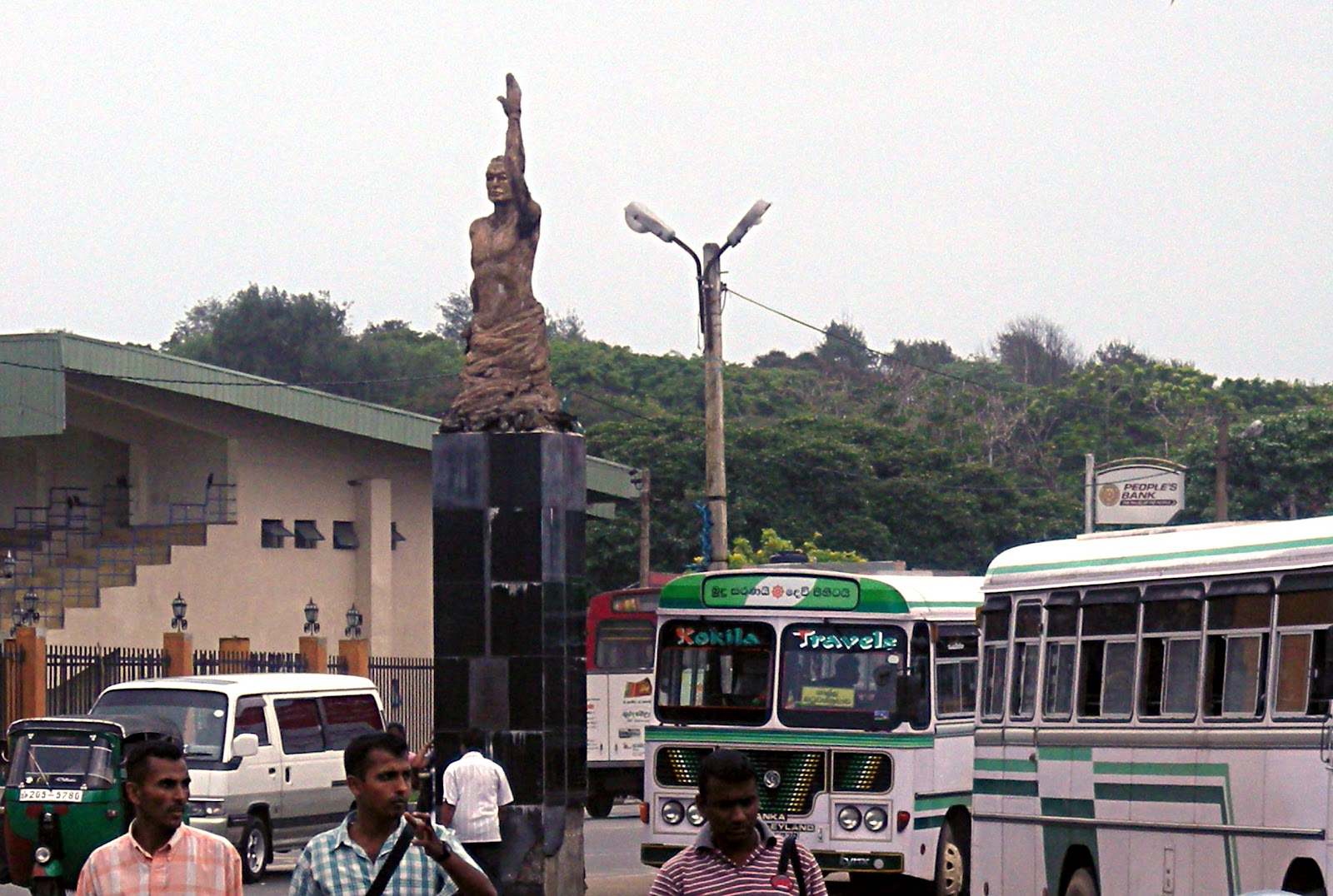
Galle town - statue in the back was built to mark height of the tsunami waters when Gale was hit in 2004. The town was entirely wiped out.

One of the main attractions in Galle is the Galle Fort. Overlooking the Bay of Galle, this historical monument was first built in 1588 by the Portuguese. It was then extensively fortified by the Dutch during the 17th century from 1649 onwards. It is now an archaeological and architectural heritage monument.


Galle Fort and the calm sea at that time of our visit. According to our guide however, this was where the tsunami waters came from the sea and went right inland.


The Dutch brought labourers from Indonesia and Mozambique to build this massive fort. Upon its completion there was already a mixed community that lived within the fort. The significant population of Muslim neighborhoods gave rise to building of the magnificent Meeran Jumma Masjid.


Meeran Jumma Masjid is an important landmark to the large Muslim community who live within the Fort.

To the beholder, the mosque can in fact pass off for a church. Yet, it holds distinctive features to the Muslim culture, which is shown palpably through the intricate designs of the crescent and the star shapes.
The entrance of this architecturally beautiful building, which rises majestically with its unrivaled white splendor, amidst the background of the fort.

Prayer hall

Ablution area


The area is also called the Old Arab Quarters. 

The Meeran Jumma Masjid is over three hundred years old.


There was also a lighthouse close to the mosque. The old lighthouse is at a height of 92 feet above low-water. It was built in 1848, however was burnt down in 1936.

A new lighthouse now stood in place.

View of the mosque from the lighthouse. A local man approached Abe with some old antique Dutch coins. Being a coin collector himself, Abe managed to get some really peculiar looking coins.  

View of the sea - all so calm......

but one just couldn't help imagine how it was that day when the tsunami hit......

Friday, July 27, 2012

Mosque Hunt - Pettah, Colombo

Alhamdulillah....it's almost been a week of fasting. Time flies and it goes faster by the day. InshaAllah may we be given more sabr and taqwa to observe and fulfill His Commands. And may we be forgiven of our sins and shortcomings and may He always keeps us in the company of righteous muslims.

In the spirit of this holy month Ramadhan, I'll try to feature some of the mosques I've visited during my travels. Many are relatively old – dating hundreds of years, whispering stories of the days long gone and the generations of people who have lived in and around it.

As obvious as some may be, many of these sacred places of worship were located rather remote and not easily accessible. More often than not, those preconceived visual display of mosques looking like what they are in our country were not of any help.

I have been wrong many times. What stood in front of my very eyes would humble me - drumming this message of how lucky and blessed we are. We see in sincere moderations, evidence of minority Muslims striving hard at continuously propagating the message of Islam and conquering the hearts and minds of others around them.

Colombo in Sri Lanka was a city I visited sometime in 2010. Often referred as the capital of the country, the city reflects trade culture of the past and showcases many historic colonial buildings. Its colonial architectural marvels thousands of travelers to witness the heydays of Dutch and British era.


Pettah is a place where Sri Lanka's multi-culturalism at its most pronounced. A bazaar with definite Middle Eastern flair is known for its narrow streets, clogged with tuk-tuks and and bewildering assortment of shops buzzing with activities. The district has long been inhabited by Muslims, but a strong population of Sinhalese and Tamils contribute to its intoxicating mix of ethnicities.


Smacked in the alleys piled with crammed goods of colourful textiles, gold and silver, and colonial-era antiquities is the Jamiul Alfar Mosque. Its name reflects a long-standing heritage of contact with the Arab world. Built at the beginning of the 20th century, it is decoratively patterned with red and white brick- work.


The mosque is one architectural monument - enriched in Islamic culture along with its majestic colonial English looking structural detailing. Its close proximity to the Colombo Ports also provides a scenic yet very spiritual environment.


Acknowledged as a character to the neighborhood and yet visually pleasing and cohesive, the Jamiul Alfar Mosque is a special place for thousands of Muslims in upholding the teachings of Islam and its benevolent values.


Scene just before solat


Juicy rambutans was in season

Fresh bread loaves could be found in many of the coffee shops in Pettah area

Sunday, August 15, 2010

Rezeki Ramadan

Whilst it's very common amongst some of my bachelor staff, I have never done it before - iftar at the mosque. When asked if the food is good, their reply would be, "Used to be better last time. Now barang mahal, so portion is smaller."

El Mursi Abul Abbas Mosque, Alexandria, Egypt

Well, I told them that they should be thankful as there are Hamba Allah who are generous enough to sedekah iftar to them. Cukup memadai untuk melepaskan rasa lapar dan dahaga ketika berpuasa dan free lagi; they should all be so bersyukur.

Each night before the start of terawikh prayers at the Shah Alam mosque, we see cleaners dutifully performing their tasks at cleaning the mess from the earlier iftar. Loads of rubbish in black garbage bags are hauled onto their lorries for disposal. I believe the SA mosque has its program for iftar with orphanages, old folks homes, government offices and also the ordinary public. All I believe are sedekah from individuals and organizations. Alhamdullilah.


Ayoubids design at El Mursi Abul Abbas Mosque. Minarets are 73m high.

One would know if there was a "berbuka besar" at the mosque when the car park is all full, and lines of vehicles parked haphazardly along the roads - resulting a bad crawl for jemaahs like us who head for terawikh. The management of SA mosque has no doubt deployed extra hands at manning the traffic, but you know how it is with our people lah - puasa or no puasa.

Anyway, that's the least of my irk. What bothers me most is when I see many of those who have gone for iftar at the mosque earlier are making their exit at the call of the azan. Ohhh....orang berlumba-lumba nak gi solat and dia berlumba-lumba nak pulang, and to the mosque just for the free meal?? Regrettably, this is what I see happening at the SA mosque Ramadan after Ramadan....sigh.

Interior of the mosque

I am refraining myself from elaborating my thoughts and comments on what I saw. Biarlah apa yang dilihat dijadikan iktibar only onto myself.

The mimbar


Note to myself - Yang baik itu kita jadikan tauladan dan yang buruk itu dijadikan sempadan.

~Kelebihan Memberi Makan Ketika Berbuka Puasa Diriwayatkan daripada Zaid bin Khalid al-Juhaniy r.a katanya: Rasulullah s.a.w bersabda: "Sesiapa yang menjemput orang yang berpuasa untuk berbuka, dia akan mendapat pahala sebagaimana pahala orang yang berpuasa itu tanpa mengurangkan sedikitpun pahala orang yang berpuasa tersebut."~

Thursday, August 12, 2010

Ramadan Day Two

Salams. It's our second day at fasting today. Alhamdulillah, things are smooth sailing both in the home and office fronts.

Of course there are still little challenges; like the many, many times of calling out to the kids to be up for sahur plus braving inconsiderate drivers cutting queues at the already chocked roads during the traffic rush back home for iftar.

Time and time again I remind myself to be patient and be thankful with this beautiful life.
Syukur.


Note to myself - Kelebihan Solat Tarawih Malam Ketiga

~Para malaikat di bawah 'Arasy menyeru kepada manusia yang mengerjakan solat Tarawih itu agar meneruskan solatnya pada malam-malam yang lain, semoga Allah akan mengampunkan dosa-dosa mereka.~